Polyaluminum Chloride (PAC)
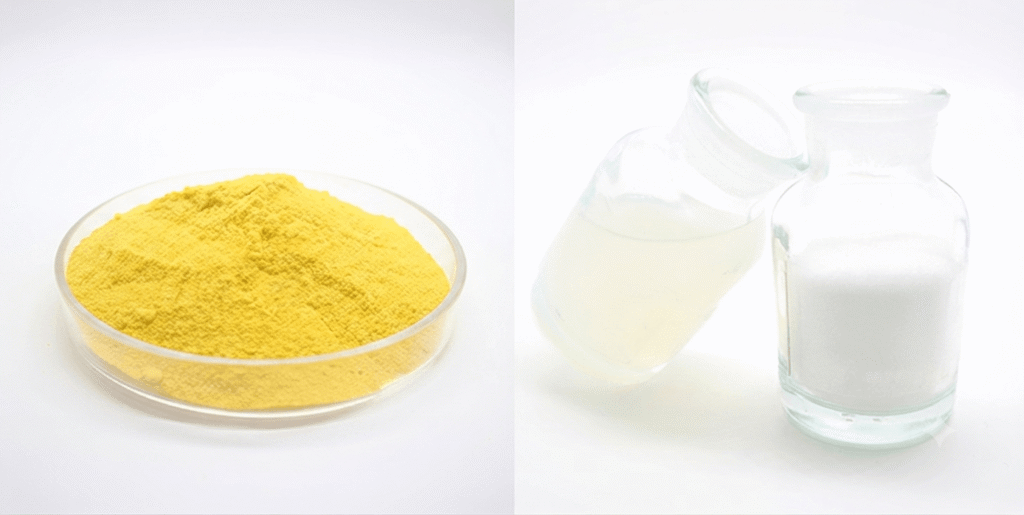
Polyaluminum chloride (PAC), referred to as polyaluminum for short, Poly Aluminium Chloride dosing In Water Treatment,has the chemical formula Al₂Cln(OH)₆-n. Polyaluminum Chloride Coagulant is an inorganic polymer water treatment agent with large molecular weight and high charge produced by the bridging effect of hydroxide ions and the polymerization of polyvalent anions. Poly Aluminium Chloride Pac can be divided into solid and liquid in form. Solid polyaluminum Yellow, gray-green, dark brown powder. Pac liquid is easily affected by moisture and is easily soluble in water. The hydrolysis process is accompanied by physical and chemical processes such as electrochemistry, agglutination, adsorption, and precipitation, and has strong bridging adsorption properties.
1. Mechanism of action
The aqueous solution of PAC chemical is a hydrolysis product between FeCl₃ and Al(OH)₃, with colloidal charge, so it has strong adsorption to suspended solids in water, so as to achieve the purpose of coagulating suspended solids in water.
2. Product Features
● Polyaluminum chloride is chemically stable at room temperature, and will not deteriorate after long-term storage. The exposed solid polyaluminum easily absorbs moisture, but does not deteriorate, and is non-toxic and harmless.
● The pH value of the suitable water range is 4-14, but the pH value of the optimum treatment range is 6-8.
● Poly Aluminium Chloride Powder has the characteristics of small dosage, low cost, high activity, convenient operation, wide applicability and low corrosiveness.
Polyacrylamide (PAM)
Polyacrylamide (PAM) /nonionic polyacrylamide/cation polyacrylamide/anionic polyacrylamide,alias flocculant No. 3, is a water-soluble linear polymer formed by free radical polymerization of acrylamide (AM) monomer. Coagulation and flocculation process in water treatment,Polyacrylamide sds has good flocculation and can reduce friction between liquids Resistance can be divided into four types: anionic, cationic, nonionic and amphoteric according to ionic properties.
Polyacrylamide is a white powder particle, which can be dissolved in water in any proportion, the aqueous solution is uniform and transparent, and the viscosity of the aqueous solution increases significantly with the increase of the relative molecular weight of the polymer. PAM is insoluble in most organic solvents, such as formaldehyde, ethanol, acetone, ether, etc.
1. Mechanism of action
Polyacrylamide is a water-soluble polymer or polyelectrolyte. There are a certain number of polar groups in the PAM molecular chain, which can adsorb the solid particles suspended in the sewage, make bridges between the particles or through the charge neutralization, so that the particles can agglomerate to form large flocs. Therefore, polyacrylamide can accelerate the suspended solids. The sedimentation of the medium particles has a very obvious effect of accelerating the clarification of the solution and promoting filtration.
2. Notes
Polyacrylamide contains toxic unpolymerized acrylamide monomer. In the drinking water treatment stipulated in my country, the maximum allowable amount is 0.01mg/L. In order to prevent the degradation of polyacrylamide, the storage temperature of its aqueous solution should be controlled not to be higher than 40°C. In order to prevent exposure to sunlight, a small amount of stabilizer, such as sodium thiocyanate, sodium nitrite, etc., can be added to the solution. Polyacrylamide solid powder needs to be packed in iron drums covered with moisture-proof polyethylene bags or lined with polyethylene layers, and sealed to prevent exposure to high humidity.
Liquid polyacrylamide needs to be packaged and then placed in wooden barrels or iron barrels. The storage period is about 3 to 6 months. It needs to be stirred before use. The storage temperature should not be higher than 32°C and lower than 0°C.